Friday, January 30, 2009

Designing the marketplace of ideas

From a Al Roth at Market Design:
Joshua Gans and Scott Stern sent me a fascinating market design paper called Is there a market for ideas?, which performs some admirable intellectual arbitrage. They seek to combine modern insights on the unusual properties of intellectual property with some of the recent conclusions from market design.

...

They argue that some of the properties of ideas themselves make it difficult to organize successful markets for ideas along conventional lines: e.g. "...a key property of ideas - the potential for expropriation - limits the potential for market thickness and lack of congestion identified by Roth."

Among the particular examples they discuss of market designs that try to solve these problems and make markets for ideas are the scientific incentive system ("Open Science"), open source efforts such as Wikipedia, and commercial projects such as Ocean Tomo (which runs auctions for IP assets), and Innocentive (which runs a marketplace in which companies can post Challenges in need of solutions).

Edit: the link in the quote isn't working for me. Here's a better link.

Conservatism, inequality, and happiness

From this paper:
our research suggests that inequality takes a greater psychological toll on liberals than on conservatives, apparently because liberals lack ideological rationalizations that would help them frame inequality in a positive (or at least neutral) light.
Hat tip to Bryan Caplan.

Tuesday, January 27, 2009

A Puzzle

About a month ago, Razib at gnxp posted this image from Strange Maps.


There is an uncannily strong correlation between which side of the border a person would have fallen on and which party he votes for.

Matthew Yglesias and Andrew Gelman argue that this is due to persistent wealth differentials-- places which were richer in 1918 are still richer today.

I can think of two alternate explanations:

1) Persistent cultural differences. There are strong network effects for many ideas, political ideas included, and this can lead to path dependency. In other words, popular ideas can stay popular for long periods. It seems likely that, being in two different countries, there would be cultural differences between the two areas. These cultural differences could have persisted and shown up in voting patterns.

2) Coincidence. Given enough maps, one or two will eventually match up reasonably closely.

Or it could be some combination of the three. (Maybe cultural differences drive wealth differences, for example.)

Sunday, January 25, 2009

Information Overload

Some recent articles that don't deserve their own posts, but are still pretty cool:

Bryan Caplan, one of the heroes of this blog, discusses myths about parenting.

Robin Hanson on movie tastes.

Vaughan Bell at Mind Hacks reviews some useful books on irrationality.

Andrew Gelman reviews an article on social influence.

Ideology and support for economic stimulus

Paul Krugman, Mark Thoma, Tyler Cowen, and Arnold Kling discuss ideological divides in the economics profession. Generally, libertarians are expressing skepticism about economic stimulus, while liberals are wholeheartedly supporting it.

Though some are alarmed by this, it shouldn't be surprising. Changing one's mind is not an effortless process, so people will try to avoid it. In this case, economists approach the issue with a bias in one direction, and do the best they can to rationalize it.

It's especially noticeable in this case, because

1) There aren't strong incentives to be correct in this situation. A single economist is unlikely to have a large effect on the stimulus, and offering an incorrect forecast every once in a while won't destroy anyone's reputation. If, say, one of these economists was personally in charge of administering the stimulus, the bias would probably shrink. This fits with Bryan Caplan's model of rational irrationality. (Caplan himself is a blogger on EconLog with Arnold Kling.)

2) There is room for disagreement. As Arnold Kling notes, "There are no controlled experiments in macro." Thus, rationalizing is easy.


Prediction markets, like Intrade, largely solve the incentive problem, so I prefer them to public debate. It would be fascinating to see, for example, Paul Krugman and Tyler Cowen make a bet on this. However, prediction markets can't do the impossible-- they can't predict the future if the necessary information just isn't there.

Saturday, January 24, 2009

Consequences of Determinism

Jeremy Dean at PsyBlog covers a study on determinism:

In new research published in the Personality and Social Psychology Bulletin, Baumeister, Masicampo and DeWall (2009) theorise that a belief in free will may be partly what oils the wheels of society, what encourages us to treat each other respectfully. They explore this theory with three studies, two on helping behaviours and one on aggression.

...

These experiments aren't the first to examine how a belief in free will (or otherwise) affects our behaviour. In a recent study Vohs and Schooler (2008) also found that a belief in free will seems to have a positive effect on people's behaviour. In that experiment (covered by Cognitive Daily) participants whose disbelief in free will was encouraged were more likely to cheat on a test.
This reminds me of a study that found economists are more likely to defect in prisoners dilemmas.

What's going on here?

My instinctual response is that people are responding to cognitive dissonance-- as determinists/economists, it's more difficult to rationalize altruism. (Selection bias is another possibility, though the determinist study appears to have ruled that out, so it could only apply to economists.)


If you were curious, I'm a compatibilist.

Friday, January 23, 2009

Religion

Jesse Bering has a post up at Scientific American detailing most of the major theories of religion.

Short synopsis:

Theory 1- religion is an unavoidable byproduct of consciousness

Theory 2- religion encouraged conformity, and thus religious groups were more likely to survive

Theory 3- religion is personally costly, and, therefore, by being religious people signal their commitment to the group

Theory 4- religious belief has positive effects on health, and so is selected regardless of the truthfulness of the belief


I'm a bit disappointed to see no mention of the memetic theory-- that religion is a defect which natural selection hasn't had the time to correct.

Wednesday, January 21, 2009

The truth about learning

A strange thing is happening-- I've been finding post topics faster than I've been posting (I've been limiting myself to one post per day, more or less). I anticipated the opposite problem. In any case, I'll be posting more often now in a Sisyphean effort to keep up.

But back to business:

Tom Stafford has a post up at Mind Hacks detailing the neurological effects of learning:
When you learn a new thing, or get a surprise, there is a shot of a chemical messenger in your brain called dopamine. Dopamine is famous among neuroscientists for its involvement in the reward and motivation systems of the brain.

...

The reason for this electro-chemical connection between learning and drugs of reward is that our brains have obviously been designed to find learning fun.

Personally, I think this lends credence to less authoritarian educational approaches, such as the Montessori method and unschooling. On the other hand, that could just be my libertarian bias.

Do economists suffer from groupthink?

Robert Shiller argues that they do:

In his classic 1972 book, “Groupthink,” Irving L. Janis, the Yale psychologist, explained how panels of experts could make colossal mistakes. People on these panels, he said, are forever worrying about their personal relevance and effectiveness, and feel that if they deviate too far from the consensus, they will not be given a serious role. They self-censor personal doubts about the emerging group consensus if they cannot express these doubts in a formal way that conforms with apparent assumptions held by the group.

...
I was connected with the Federal Reserve System as a member the economic advisory panel of the Federal Reserve Bank of New York from 1990 until 2004, when the New York bank’s new president, Timothy F. Geithner, arrived. That panel advises the president of the New York bank, who, in turn, is vice chairman of the Federal Open Market Committee, which sets interest rates. In my position on the panel, I felt the need to use restraint. While I warned about the bubbles I believed were developing in the stock and housing markets, I did so very gently, and felt vulnerable expressing such quirky views. Deviating too far from consensus leaves one feeling potentially ostracized from the group, with the risk that one may be terminated.

Of course, economists have different incentives in their roles as expert advisers and academics. In the latter role, there is a strong reputational incentive for non-conformism (think Milton Friedman, whose claim to fame is his prediction that the mainstream Keynesian models of the time would fail.)


Hat tip to Uwe Reinhardt.

Sunday, January 18, 2009

Six degrees of separation-- just not true

Rebecca Skloot explains.

This will slow down the spread of ideas a bit.

HT: gnxp.

Reading

Here's an interesting report on reading trends courtesy of the NEA.

I didn't see it mentioned in the report, but apparently the number of people who read when they don't have to for some reason has dropped.

I wish there were some way to get this kind of information about non-fiction reading.

Friday, January 16, 2009

... Well, duh

Surprising information gets more attention.

Hat tip to New Scientist Mind Hacks.

Ideological Compatibility

Economist Ed Glaeser has an interesting essay up here.

I say interesting because he takes an unusual approach to libertarianism. Rather than arguing that small government is more efficient, he tailors the message to liberals by emphasizing egalitarianism.

In this situation, we can view libertarianism as an ideological innovation that Ed Glaeser is trying to market.

According to Everett Rogers in The Diffusion of Innovations, one of the main determinants of the diffusion of an innovation is its compatibility with other products or knowledge. Because of cognitive conservatism (resistance to changing one's mind-- the best explanation I can find online is here), it can be difficult to get people to adopt new opinions.

By proposing that libertarianism is compatible with egalitarianism, Glaeser is trying to minimize the cognitive resistance from liberals. Instead of asking them to abandon their views on egalitarianism, which would require a major ideological overhaul, he asks them to alter their views on the best strategy-- still requiring an ideological overhaul, but only a modest one.

Looking at this from an economic perspective, Glaeser is trying to lower the ideological costs of libertarianism for liberals.

Thursday, January 15, 2009

Wednesday, January 14, 2009

The Positivist Fallacy

There's a bizarre line of reasoning I often see when discussing issues of economics. It goes something like this:

"Well, sure, your theory says such and such, but that's all theory-- I'm looking at reality here. My political views are superior because I don't rely on theory to inform my beliefs-- I just look at statistics and go from there."

This thinking is really just a rehash of the positivism popular in the early 1900s. It fell out of favor because philosophers realized that it's impossible to derive knowledge from experiments without some kind of underlying theory. Paul Krugman sums up the problem in an essay criticizing William Greider (The Accidental Theorist), another naive positivist:

"I think I know what Greider would answer: that while I am talking mere theory, his argument is based on the evidence. The fact, however, is that the U.S. economy has added 45 million jobs over the past 25 years--far more jobs have been added in the service sector than have been lost in manufacturing. Greider's view, if I understand it, is that this is just a reprieve--that any day now, the whole economy will start looking like the steel industry. But this is a purely theoretical prediction. And Greider's theorizing is all the more speculative and simplistic because he is an accidental theorist, a theorist despite himself--because he and his unwary readers imagine that his conclusions simply emerge from the facts, unaware that they are driven by implicit assumptions that could not survive the light of day."

So why is this patently absurd thinking so common? And why is it especially common with economics?

Human brains have evolved to look for patterns. The world is supposed to make sense. To someone who hasn't studied academic economics, it's incredibly difficult to make sense of the economic world (speaking from personal experience). As a result, many people give up trying and resort to positivism. This approach is supposed to avoid the messiness of theoretical economics.

Ironically, economics isn't very messy if you take the time to learn it. It's odd that it's popularly viewed that way-- maybe this is because people don't like the idea that their behavior can be studied scientifically, or maybe it's because economists in the media usually don't agree on how to apply economics to current events. This is not something I'm prepared to try to explain yet-- maybe later.

Sunday, January 11, 2009

Steven Pinker's Genes

New York Times article here.

Saturday, January 10, 2009

Where This Blog Is Going

I've decided I'm going to focus primarily on memetics here, and move all the anarchism material to FreeKeene.com. I feel like the blog is schizophrenic when I try to cover both.

I'll change the blog up a bit to reflect the new focus, though I won't take away all of the anarchism/libertarianism. I've also been ramming my way through the relevant literature (including some of the popular memetics books, even though I tend to think lowly them). We'll see where that leads.


So The Spiral is now officially a memetics blog.

Tuesday, January 6, 2009

Agorism, pt. 2: The Mafia

(pt. 1)

There was a time when agorism was widespread: Prohibition. And the outcome suggests more problems for agorist theory.

The prohibition of alcohol created a perfect situation for black markets, an they obligingly appeared. The result was not predicted by Konkin's agorist theory-- instead of an ever-expanding black market leading to the end of the state, prohibition led to a huge increase in organized crime, which eventually prompted the end of prohibition.

Most agorists would predict that security on black markets would be provided by competing security companies-- basically, a black-market microcosm of full-scale market anarchism. What went wrong?

The problem, predictably, lies with the government. Black market entrepreneurs, in order to protect their businesses from government interference, were forced to bribe politicians-- rent-seeking. But of course, the rent-seeking didn't end there. Black market businesses began using politicians for other purposes-- paying them to bust up their competition while leaving the business with a territorial monopoly on its product. Thus, government corruption turns black market security production into black market governments.

This is undeniably a major problem for agorists. Not only because it creates governments, but because it creates the political will to remove the offending laws in order to get rid of the mafia. When the political scenario favors agorism, it gets altered. Large-scale agorism is self-defeating.


I had a great source for all of this history, but I can't find it right now. (Damnit!)

Thursday, January 1, 2009

Still Alive

I work a ridiculous amount during the holidays.

Anyway, Eliezer Yudkowsky at Overcoming Bias has an interesting comment on why political ideas just won't die:

our brains simply haven't updated to their diminished power in a super-Dunbarian world. We just go on debating politics, feverishly applying our valuable brain time to finding better ways to run the world, with just the same fervent intensity that would be appropriate if we were in a small tribe where we could persuade people to change things.


My schedule should slow down soon, and the blog should speed up accordingly.

Friday, December 19, 2008

Memes

Nice post on topic popularity, at ICCI.

Iraq war veterans who have killed respond to cognitive dissonance, at Scientific American.

Religion may effect what you perceive.

Wall Street Journal op-ed hints at a brilliant recession fighting strategy-- end the war on drugs.

These are all awesome links, I stole them all from Mind Hacks, and I'll probably do some follow up on them.

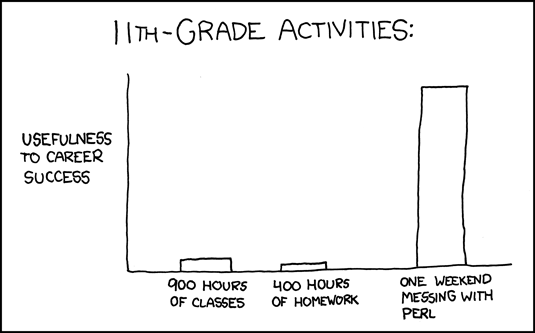
The signaling theory of education

Randall Munroe joins the club:

Thursday, December 18, 2008

Network Effects, Path Dependency, and Multiple Equilibria

I'm taking the time to explain these concepts because they are going to be common in upcoming posts.


Supply-and-demand graphs are all well and good, but in some situations there is more to the story. This post covers markets where the quantity of a good affects the demand.


Imagine you are the first person on the planet to buy a telephone. As far as talking with other people goes, the phone is worthless. You'd be better off playing checkers with yourself.

But now that you have a phone, if someone else buys a phone, he will have someone to talk to. The benefits of a phone have risen. As more and more people buy phones, the benefits of a phone rise higher and higher. This is called a network effect.

Network effects aren't the end of the story. But let me change the example- the use of the same computer operating system has network effects, and so, as more people adopt Microsoft, it causes more people to adopt, until Microsoft has a near-monopoly. Now that Microsoft is widespread, let's say a better operating system comes along -- Apple. Because it's better than Microsoft, it would usually be adopted. But, thanks to the network effects, it may actually be better for each individual to keep using Microsoft. Microsoft, with widespread use, is better than Apple without widespread use. Since no one ever uses Apple, it can't build up the network effect, and people stay with Microsoft- the poorer system. It is collectively rational to switch systems, but it is individually rational to stick with Microsoft. This is called path dependency.

When variables interact with each other like this, there is no one economic optimum that can be found with a supply-and-demand graph. A more appropriate graph looks like this:
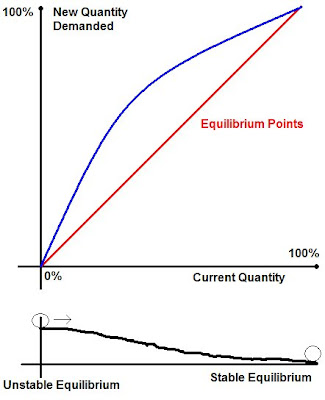
The blue curve represents the demand given a certain percentage of adoption. So, for example, if the curve represented cell phone demand, and 50% of the population has a cell phone, about 75% would want one (50% already have one, and 25% go out and buy one).

The red curve represents all the equilibrium points. These are the points where the current quantity is the same as the desired quantity, so, once a society reaches one of these points, there are no further changes.

The demand will move along the blue curve until it hits an equilibrium point on the red curve. In this case, where there are positive network effects, the demand would increase until it intersects with the red curve at 100%. (If there were negative network effects, the blue curve would be below the red curve.) If we start at 10%, about 20% would be demanded, and we'd go from there to 50%, then to 75%, and so on to 100%.

0% is also an equilibrium point. It is unstable, however, because any deviation from 0%, however small, will launch demand back to 100%. The rolling balls below the graph represent this (yes, the circles are supposed to be rolling balls). The ball can balance precariously at 0%, but any small gust may start it rolling to 100%.

100% is stable, because small deviations lead back to 100%.


These effects, though irrelevant for much of economics, are more important for memetics.

Marijuana


I know this kid. Cool guy.

Hope he doesn't end up in jail for too long.

Friday, December 12, 2008

Agorism, pt. 1: A Simple Model

Libertarians are in a dilemma when it comes to politics. On the one hand, most are very pessimistic about political action: markets work, politics doesn't. On the other hand, it seems that the only way to a libertarian society is politics.

To solve this, Samuel Konkin proposed a market solution (agora = market). In a long polemic, he claimed that by working on the black market, libertarians could spur a gradual economic secession from the state. More and more people decide to work on the black market, until the state either gives up or loses all relevance.

The Model

Like their legal counterparts, black market entrepreneurs respond to incentives. Thus, black market activity can be modeled economically.


A black market entrepreneur avoids taxation and regulation, and this acts as a subsidy for his business, relative to his legal counterparts. He also pays extra to escape government harassment, and this acts as a tax.

The main determinant of the existence of a black market is the relative sizes of the subsidy and the tax. If the subsidy is greater than the tax, the good is provided cheaper on the black market, and the black market thrives. If the reverse, it's provided legally.


Konkin isn't very clear about why he expects agorism to succeed, but the 28 years since the publication of his essay have not been kind to his thesis. Black markets have only been widespread for goods that have been outlawed — marijuana, illegal immigrant labor, and so on. (In cases where a good is banned, its legal price is infinity— it can't be bought legally— and this guarantees it will be sold on the black market, if at all.)


Later I will discuss network effects, more problems with agorism, possible solutions, and the potential of this strategy.

(pt. 2)

Tuesday, December 9, 2008

Samuel Kernell is a fan of my work

My review of his textbook on Amazon, that is.

I got this in my email:

Hi, I just went out to amazon to check the price of Logic’s 4th edition and spotted your defense of the text. Thanks, sam

Samuel Kernell

Dept. of Political Science

U.C. San Diego

La Jolla, CA 92093-0521

http://polisci.ucsd.edu/faculty/kernell.htm


By the way, his textbook is awesome.